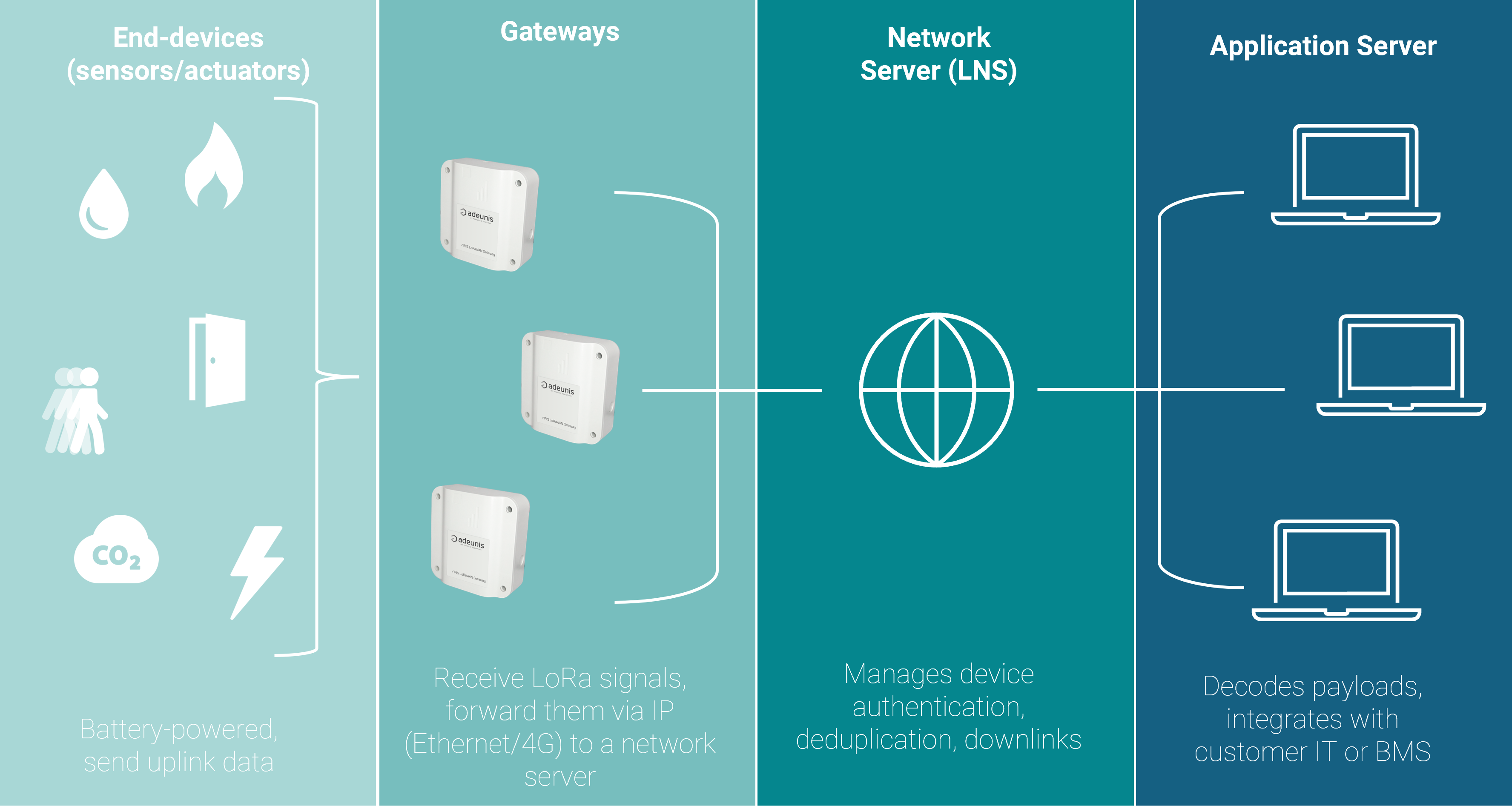
Sensors send their data via the LoRaWAN protocol (uplinks), either periodically or on specific events.
One or more gateways receive the same frame (depending on coverage).
The gateway encapsulates and forwards the frame to a LoRaWAN server (LNS) via an IP connection:
Ethernet (LAN/VLAN)
Cellular (4G/5G)
Sometimes Wi-Fi, VPN, private network, etc.
The LoRaWAN server processes LoRaWAN security (authentication, frame counters, keys), manages application routing, and then forwards the data to your applications (MQTT, HTTP, etc.).

Le partenaire pour la captation, transmission et mise à disposition de vos données
In an IoT project, each sensor is a source of data. However, without a reliable connectivity chain between the radio layer and your business platform, this data remains difficult to exploit: intermittent data loss, uneven coverage, poorly controlled security, and complex integration.
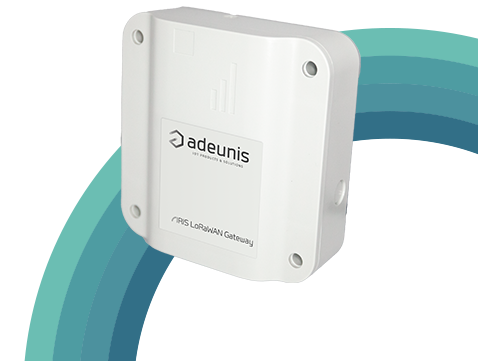
A LoRaWAN gateway (also known as a LoRaWAN gateway device) plays a central role in this chain. It receives the LoRaWAN radio frames transmitted by sensors and forwards them to your IP infrastructure (LAN, 4G/5G, Wi-Fi, etc.), enabling your LoRaWAN Network Server (LNS) and applications to process the data effectively.
In short — What a LoRaWAN gateway actually delivers
1
Long-range coverage and improved indoor penetration, with minimal infrastructure.
2
Simplified deployment: a single radio collection point for dozens or even hundreds of sensors.
3
Interoperability with major LoRaWAN network servers (ChirpStack, The Things Stack / TTN, Actility, Requea, etc.), depending on the operating mode (packet forwarder, Basics Station, embedded LNS).
4
End-to-end security: LoRaWAN security (keys, authentication, frame counters) combined with IP security (TLS, certificates), depending on the transport layer.
1- What is a LoRaWAN gateway? What is its role?
A LoRaWAN gateway is a device that listens to LoRa radio traffic transmitted by your sensors and then forwards it to a LoRaWAN server (LNS — LoRaWAN Network Server) via an IP connection (Ethernet, cellular, and in some cases Wi-Fi, depending on the model).
Whether you are deploying 20 sensors in a single building or 2,000 across multiple sites, the gateway is a key component: it determines radio coverage, service quality, security, monitoring, and ease of deployment.
2. How does a LoRaWAN gateway work?
A LoRaWAN gateway sits at the interface between the radio layer (LoRaWAN) and the IP network.
Field-side steps:

And what about commands?
When an application needs to act on a sensor, it triggers a downlink:
Application → LoRaWAN server → Gateway → sensor, at the moment the sensor opens a receive window (particularly for Class A devices).
Key point to understand:
The gateway does not necessarily “decode” the application data. Depending on the architecture, payload decoding can be done in the IoT platform, in the LNS, or via a dedicated tool (codec/decoder). The essential role of the gateway is to ensure reliable radio collection and network transmission.
3. Possible operating modes (gateway side)
Depending on the gateway and your strategy, the device can be connected in several ways:
a) Packet Forwarder to an external LoRaWAN server (LNS)
This is the most common setup: the gateway forwards frames to an external LNS. Two main types exist:
UDP packet forwarder (legacy, simple)
Basics Station (WS/WSS) (more modern, often preferred in production)
b) Embedded LoRaWAN server
The gateway can also host the LNS locally for private or isolated networks. Typical advantages:
Local autonomy (useful for isolated sites)
Simplicity for “standalone” deployments
LoRaWAN administration directly on the device (depending on implementation)
The right choice mainly depends on your context: multi-site deployments, IT requirements, network exposure, operation and monitoring, security policies, scalability needs, etc.
4. Key features and benefits of a LoRaWAN gateway
The gateway plays a crucial role in deploying an IoT network.
Cover large areas with minimal infrastructure
LoRaWAN is designed for long-range transmission with minimal sensor-side power consumption. As a result:
fewer access points than a dense network
less cabling
reduced on-site maintenance
Benefit: cover an industrial site, multiple buildings, or even a neighbourhood with a limited number of gateways.
Simplify network architecture
Instead of having “one sensor = one IP connection,” you have:
LoRaWAN sensors on the radio side
a gateway that forwards data to IP
an LNS that centralises and distributes the data
Benefit: reduced network complexity, fewer firewall openings, and lower operational costs.
Ensure bidirectional communication
LoRaWAN supports downlinks (messages from the network to the sensors):
Reconfiguration (thresholds, transmission frequency)
One-off commands
Certain maintenance scenarios
Enhance security and reliability
LoRaWAN security: AES-128 encryption at the LoRaWAN level, message integrity (MIC), frame counter management to prevent replay attacks.
IP security (depending on mode): Basics Station typically uses WSS/TLS, with certificate validation (CA), which requires correct time (NTP) and a properly configured CA certificate store if needed.
Availability: monitoring, connectivity watchdog (depending on model), alerts.
Scale up (scalability)
A LoRaWAN gateway is designed to:
handle a high volume of radio messages
integrate with monitoring tools
enable multi-site deployments (fleet management depending on the solution)
Benefit: you can start small (POC) and scale up without reinventing your infrastructure.
5. Practical applications

Connected buildings
Smart Building
Energy monitoring (meters, sub-metering, consumption tracking)
Comfort (temperature, CO₂, humidity)
Maintenance (leaks, malfunctions, alerts)
Security (access points, technical rooms)
Value: reduce energy consumption, limit interventions, and support data-driven decisions.

Industry and predictive maintenance
Vibration/temperature monitoring on equipment
Usage counting, cycles, pressure
Alerts for deviations, thresholds, anomalies
Reduced unplanned downtime
Value: maximise equipment availability and plan maintenance based on actual data.

Smart cities
Intelligent cities
Street lighting, parking management
Environment (pollution, temperature, humidity)
Remote reading, fill-level monitoring, asset supervision
Value: optimise urban services and reduce operating costs.
6. Example

Context
A multi-building site (light industry/office), 120 LoRaWAN sensors (temperature, pulse counting, air quality, access points).

Objective
Reliable data collection + central monitoring + alerts.
Typical architecture
2 LoRaWAN gateways installed at height (redundant coverage)
Ethernet backhaul on the client LAN (or LTE if no LAN available)
LNS hosted (cloud/on-prem) or embedded server, depending on constraints
Application integration via MQTT/HTTPS to the platform
Outcome:
Faster deployment compared to a wired network
Wide coverage with minimal equipment
Centralised data management (dashboards + alerts)
Ability to add or replace sensors without disrupting the system
Conclusion
A LoRaWAN gateway is not “just a relay”: it is the critical junction between the radio and IP networks, determining data collection quality, deployment ease, and operational reliability.
Investing in a robust, well-integrated LoRaWAN gateway reduces deployment risks, speeds up commissioning, and ensures your IoT data becomes truly actionable.
20/01/2026