
Le partenaire pour la captation, transmission et mise à disposition de vos données
In an IoT project, the quality of sensors alone is not enough to guarantee the overall performance of the system.
The real value of a deployment relies on an often less visible but decisive element: the network architecture that carries, secures and structures the data.
Without a reliable network, sensors remain isolated. Without reliable data, no control or decision-making is possible.
In this context, LoRaWAN has established itself as one of the reference technologies for connecting devices over long distances, with very low power consumption and a high level of deployment flexibility.
However, reducing LoRaWAN to a simple radio technology would be a mistake.
In reality, it is a complete architecture that organises data flow from the field up to business platforms, integrating security mechanisms, monitoring and traffic management.
Scalability, coverage, reliability, monitoring: these parameters are not optional. They directly determine the success of an IoT project.
This is why a high-performing IoT project relies above all on a properly designed and fully controlled LoRaWAN network from the architecture phase onwards.
LoRaWAN: Everything You Need to Know
What is a LoRaWAN network?
LoRaWAN is a communication protocol designed to connect devices over long distances, with minimal energy consumption.
It enables IoT sensors to transmit data to centralised processing systems, even in complex environments such as commercial buildings or industrial sites.
Its strength lies in its simplicity on the field side:
- no wiring required for installation
- minimal local infrastructure required
- long battery life for sensors
- wide coverage, including indoor environments
Behind this apparent simplicity, LoRaWAN is based on a structured and secure network architecture, composed of several complementary building blocks.
How does a LoRaWAN architecture work?
A LoRaWAN network operates like a continuous chain: each link has a specific role, from measurement in the field to data usage within a business platform.
What makes this architecture effective is its ability to separate functions:
- IoT sensors perform measurements
- the network transports data
- servers organise information
- platforms turn data into actionable insights
This end-to-end logic is what makes a building or site truly controllable and manageable.
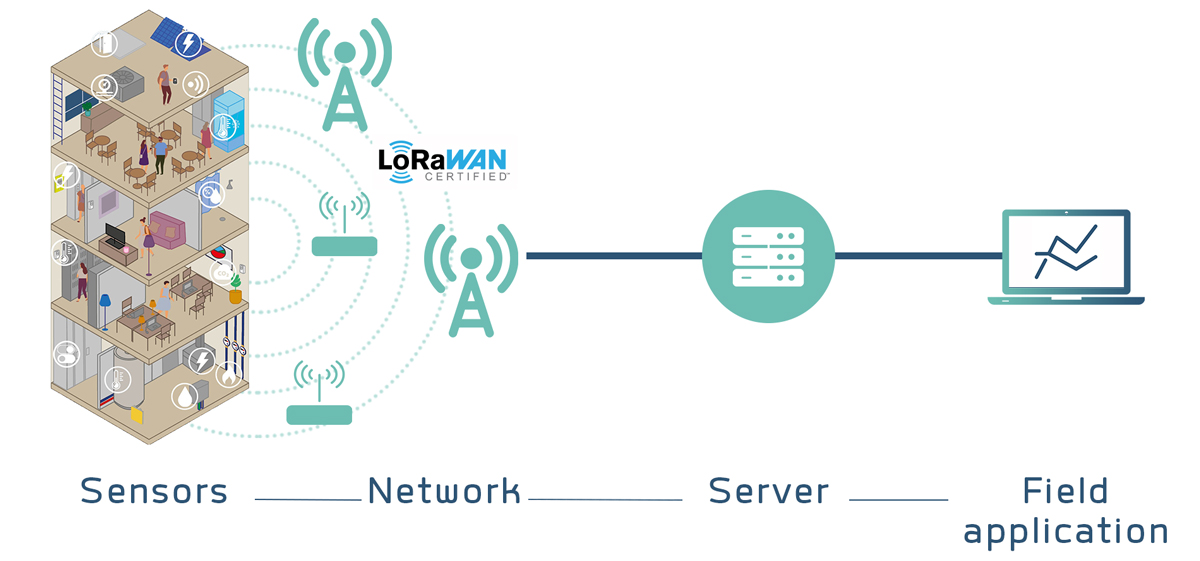
IoT sensors: the starting point of data
Everything starts in the field.
IoT sensors measure physical or technical data: temperature, humidity, energy consumption, equipment status, anomaly detection, and more.
They are designed to operate autonomously, often on battery power, allowing for quick installation without construction work or wiring.
In some cases, they can also be mains-powered, particularly when continuous monitoring or high-frequency measurements are required.
This power supply aspect is directly linked to a key challenge: sensor energy autonomy.
For battery-powered sensors, the goal is to maximise lifespan (sometimes several years, or even over 10 years depending on use cases). This requires optimising data transmission frequency and the amount of information sent.
Conversely, a continuously powered sensor allows more flexibility, particularly for industrial use cases or higher-frequency measurements.
The choice of sensor is therefore never neutral: it directly defines the deployment and network strategy.
The LoRaWAN network: the transport layer
Before even discussing sensors or on-site equipment, a LoRaWAN project starts with a fundamental question: how will data be transmitted?
The LoRaWAN network forms the transport layer of the IoT architecture. It ensures the transmission of data collected in the field to the systems that will process and use it.
In practice, two network models coexist: private LoRaWAN networks and public (or managed) LoRaWAN networks.
A public LoRaWAN network relies on an existing infrastructure deployed and operated by a provider. Sensors use this network to transmit data without the need to deploy local infrastructure. This approach enables fast deployments and multi-site projects, particularly when devices are geographically distributed.
Simplified diagram of a public (managed) LoRaWAN architecture

The private LoRaWAN network, on the other hand, relies on a dedicated infrastructure installed on-site. It enables the creation of a controlled local network, tailored to the specific constraints of a building, industrial site or technical estate. This approach offers finer control over network coverage and data flow management.
Simplified diagram of a private LoRaWAN architecture

Public or private LoRaWAN network: which should you choose?
The choice between a public and a private network is a key decision in any IoT project.
There is no universal solution. The right choice depends on the use case, the required level of control, and the site constraints.
The public network prioritises simplicity and rapid deployment, particularly for multi-site projects.
The private network prioritises control, coverage management, and adaptation to complex environments.
In most projects, this decision is refined based on on-site analysis and a radio frequency assessment phase.
Summary table: private vs public LoRaWAN
| Criterion | Private network | Public network |
|---|---|---|
| Control | The administrator has full control over network parameters | Open access to all users (usually subject to a subscription fee) |
| Coverage | Predictable and stable performance. Limited to the company’s local area network (LAN) | Nationwide coverage. May be limited in environments with obstacles (buildings, hills, underground spaces…) or depending on the number of connected devices in the area |
| Deployment | Requires the deployment of dedicated infrastructure (sensors + gateway + server) | Quick to deploy, only requires connecting the sensors |
| Data security | Full control, strong data confidentiality management | Security managed by the operator, data is shared |
| Cost | Gateway purchase + possibly subscription or licence fees | Per-device subscription, recurring costs |
| Maintenance | Managed locally | Managed by the public network operator |
| Interoperability | Customisable according to specific needs | Standardised protocol, ensured interoperability |
| Dependency | Autonomous, no dependency on an external operator | Dependent on the operator’s network coverage and quality |
| Flexibility | High, ability to customise architecture and transmission frequencies | Less flexible, subject to operator constraints |
Private network: LoRaWAN gateways, the field interface
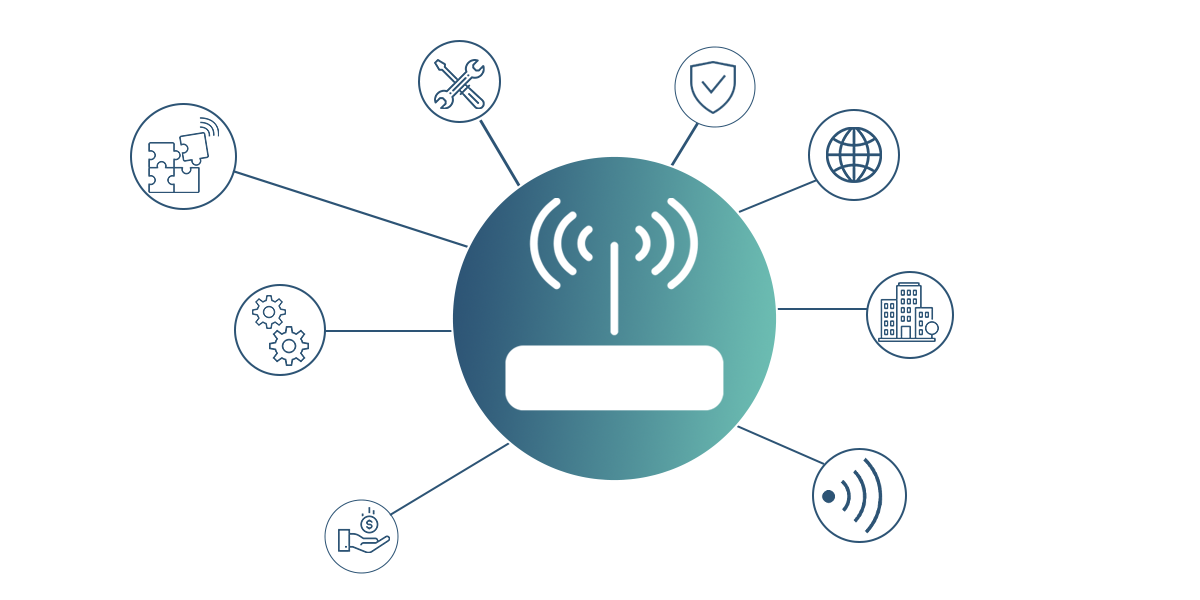
In a private architecture, LoRaWAN gateways are responsible for receiving signals from sensors and forwarding them to the IP network.
They act as the bridge between the field and the network infrastructure.
Their performance directly depends on their positioning.
Poor placement can degrade overall site coverage, even when a sufficient number of sensors is deployed.
This is why their deployment is preceded by a radio analysis phase (radio mapping), which helps identify optimal coverage areas.
In public networks, this infrastructure is operated by connectivity providers. The customer therefore does not directly manage the gateways.
Key takeaways: Private vs public LoRaWAN networks
1
Fast deployment
Public LoRaWAN networks enable rapid deployment without any local infrastructure.
2
Coverage control
Private networks provide greater control over coverage and data flows.
3
Adapt to your IoT project
The choice mainly depends on the required level of control and the specific constraints of each IoT project.
The Network Server: the control core
Once data is transmitted by the gateways, it is handled by a central component of the LoRaWAN architecture: the network server.
This is a critical building block, often invisible in IoT projects, but essential to ensuring reliability, security and consistency of data exchanges.
The network server acts as an orchestration point between sensors and application platforms.
It performs several key functions:
- managing communications between devices and the central system
- authenticating devices when joining the network (join process / OTAA)
- managing security keys and encrypting communications
- removing duplicates caused by radio transmission
- structuring and routing data to the appropriate platforms
In a LoRaWAN architecture, this layer ensures that only authorised devices can communicate and that transmitted data is reliable and usable.
Without this component, information would simply be transported, without any guarantee of integrity or security.
Business platforms: turning data into action
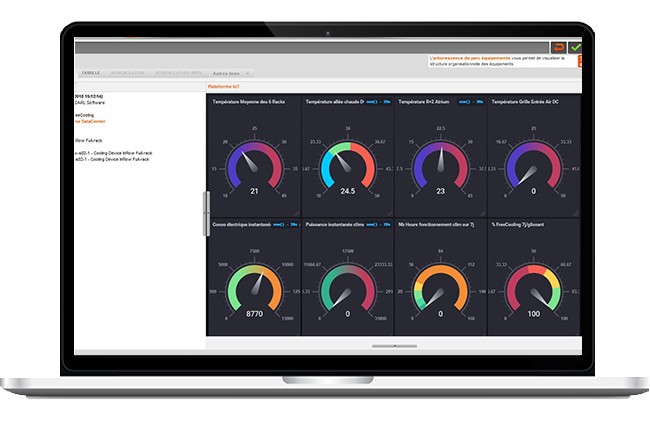
Once the data has been processed by the network server, it is sent to application platforms.
This is the stage where IoT data truly delivers value.
These platforms make it possible to turn technical data streams into actionable information for operational teams.
They are used in particular to:
- visualise data through dashboards
- monitor equipment status or energy consumption
- generate alerts in the event of anomalies
- integrate data into existing systems such as a BMS (Building Management System)
- trigger automated actions based on defined thresholds
In some cases, the system can even go as far as automated control logic. For example, an abnormal temperature variation may trigger an alert, or directly activate a ventilation system without human intervention.
This is the point where the IoT project moves from a measurement system to a true operational management tool.
How to define your LoRaWAN architecture: key questions to ask
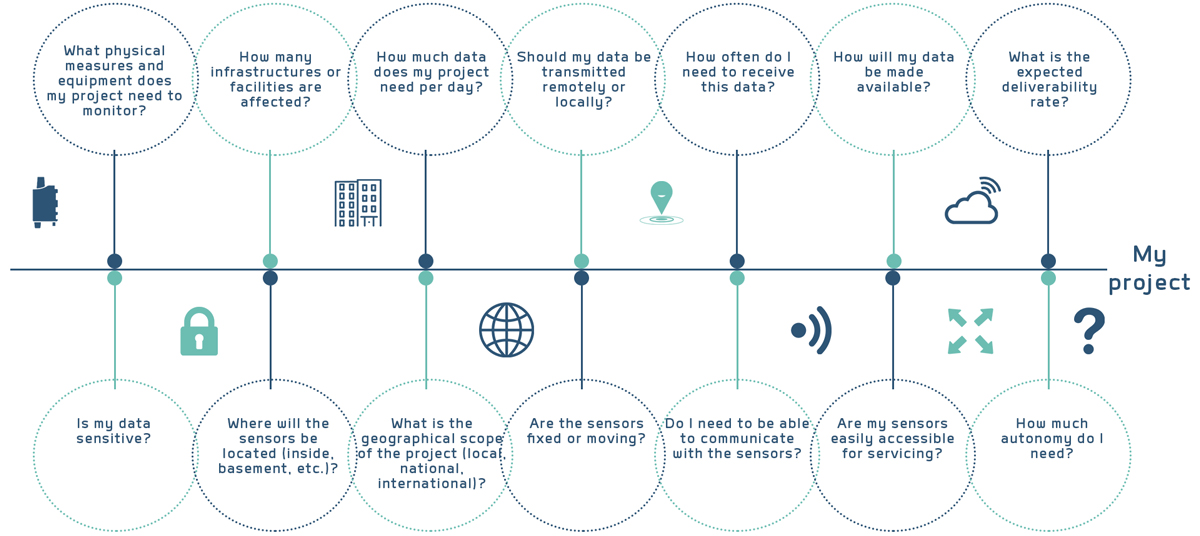
3. How can you ensure good LoRaWAN coverage?
The quality of a LoRaWAN network does not depend solely on the choice of technology or the initial architecture. It mainly relies on a often underestimated factor: real-world coverage in the field.
In a building, an industrial site or a multi-site environment, radio signal propagation can vary significantly depending on the environment: materials, obstacles, distances, interference, and so on.
This is why the radio design phase is critical to ensure long-term network reliability.
The role of radio mapping
Before any sensor installation, it is essential to assess how the network behaves on-site.
This is the purpose of radio mapping.
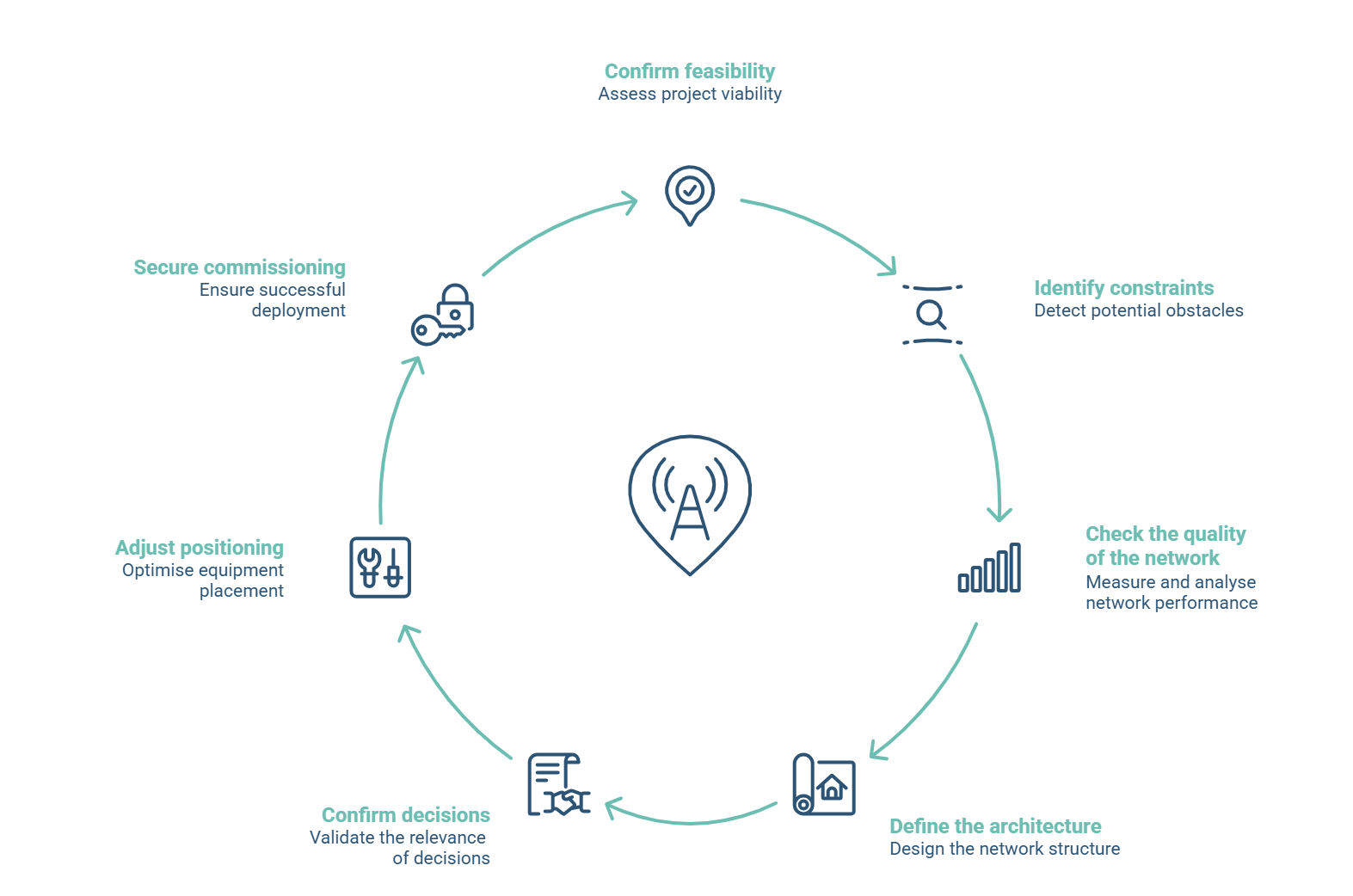
This step makes it possible to measure signal reception quality across different areas of a building or site, in order to anticipate real communication constraints.
It relies on network testing tools that simulate real-world operating conditions for field devices.
The objective is simple: avoid coverage gaps, reduce communication loss, and optimise device positioning.
Radio mapping also helps validate key network architecture choices:
- public or private network
- whether gateways need to be deployed
- expected sensor density
Why test LoRaWAN radio coverage?
Radio obstacles in buildings
In a real-world environment, the LoRaWAN signal can be influenced by many factors.
The main obstacles are often related to the building structure itself:
- thick or reinforced concrete walls
- metal structures
- basements or technical rooms
- electrical equipment generating interference
These elements can weaken signal propagation, or even create areas where communication becomes unstable.
This is why an IoT installation should never be designed purely “on paper”.
Gateway positioning
In private LoRaWAN architectures, gateway positioning is a key factor in network quality.
A poorly positioned gateway can limit overall coverage, even if a sufficient number of devices is deployed.
The goal is therefore to find a balance between:
- installation height
- central positioning within the building or site
- distance from obstacles
- coverage of critical areas
In complex projects, this positioning is directly derived from radio mapping results.
Once network coverage is under control, the project can move to full-scale deployment.
Memo: common mistakes in a LoRaWAN project
- ignoring radio mapping before deployment
- underestimating radio obstacles in buildings
- choosing a public network without assessing real coverage
- misconfiguring sensors
- positioning gateways without prior study
4- Deploying a large-scale LoRaWAN network
Once network coverage has been validated and the architecture defined, the IoT project enters a scaling phase.
LoRaWAN is particularly well suited to multi-site environments, where several buildings or geographical areas need to be connected within a single infrastructure.
In this type of configuration, each site can operate autonomously while still sending its data to a centralised platform.
This approach enables:
- standardisation of use cases across an asset portfolio
- centralised equipment monitoring
- harmonised data interpretation across sites
It is now widely used in commercial, industrial and public sector environments.
Industrialising IoT deployments
At scale, an IoT project becomes an industrialisation project.
The value no longer lies solely in the technology, but in the ability to replicate reliable, fast and consistent deployments.
This requires a structured upstream organisation:
- sensors must be prepared and configured before on-site deployment
- parameters must be standardised according to use cases
- installation procedures must be reproducible
- on-site error risks must be reduced as much as possible
In this logic, the preparation phase becomes as important as the installation itself.
It directly determines deployment quality and system stability over time.
Network supervision, maintenance and evolution
Once the network is in place, supervision becomes a central element of the system.
With tens, hundreds or even thousands of sensors, the challenge is no longer only to collect data, but to ensure that the entire system remains operational.
This involves continuous monitoring of:
- successful data transmission
- device operating status
- potential communication losses
- data consistency across sites
Supervision makes it possible to quickly identify deviations and intervene before they impact operations.
5- Device management and IoT data utilisation
Once the network is deployed and sensors are installed, the IoT project enters a more structured phase. The focus is no longer only on data transmission, but on long-term data management and the ability to maintain a coherent and fully operational device fleet.
This is precisely the role of device management: ensuring the operational continuity of the system, from the sensor through to usable data.
Monitoring and managing a sensor fleet
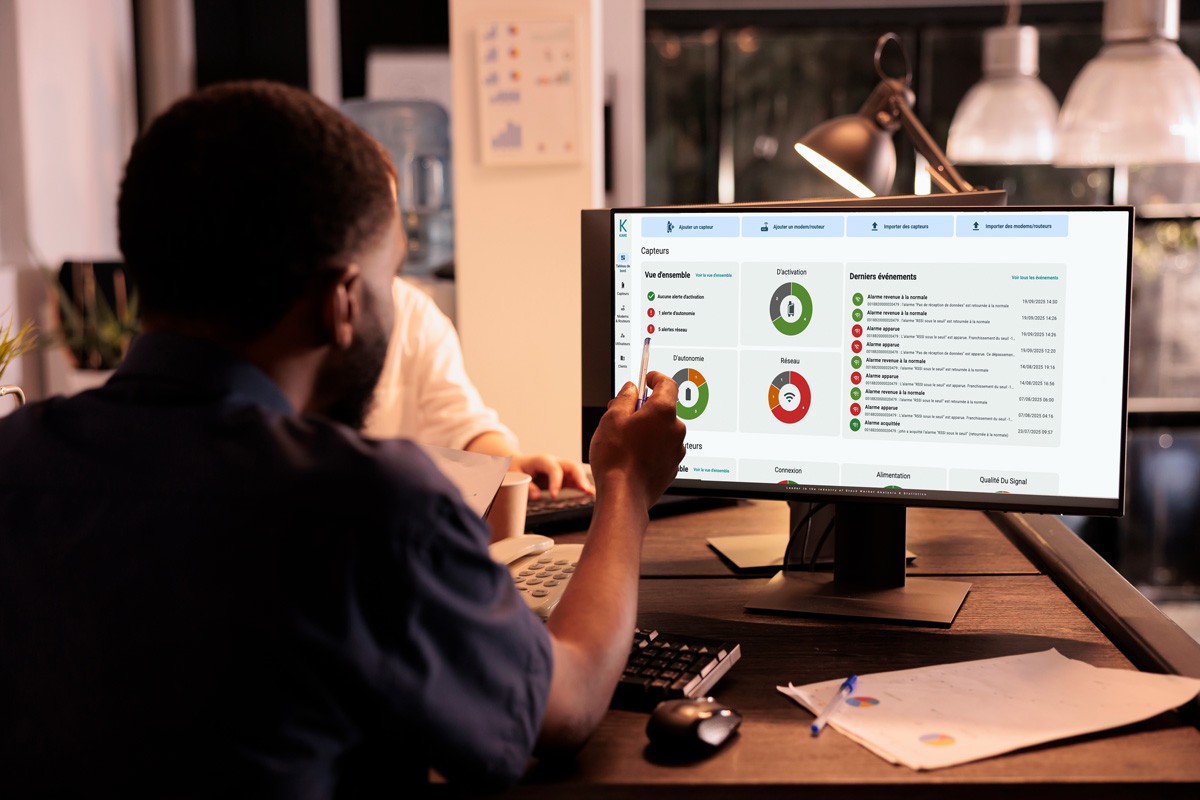
In a LoRaWAN project, the number of deployed sensors can quickly become significant. A few dozen measurement points in a single building can scale to several hundred across an entire property portfolio.
In this context, manually tracking each device becomes impractical. Device management helps address this complexity by providing a global view of the installed fleet.
It is not only about knowing whether a sensor is working or not, but understanding how it behaves over time: transmission quality, reporting frequency, and data consistency.
This continuous monitoring helps avoid blind spots in data exploitation.
Remote configuration and updates
In IoT projects, initial sensor configuration is generally not sufficient to cover the full lifecycle of the system. Use cases evolve, requirements change, and parameters must be adjusted without redesigning the infrastructure.
This is why the ability to remotely modify configurations has become a core feature of LoRaWAN architectures.
Depending on the case, sensors can be configured during on-site installation, but also adjusted later via dedicated tools or remote commands.
This flexibility reduces the need for field interventions while maintaining performance aligned with operational requirements.
6- IoT data: from decoding to operational insight

Data decoding and structuring
Data coming from IoT sensors is not directly usable. It is transmitted in the form of frames that must be interpreted before being integrated into business systems.
Decoding is therefore a key step in the IoT value chain. It transforms technical signals into understandable and usable information for operational platforms.
Once decoded, this data can be integrated into various environments, such as building management systems, energy platforms, or monitoring tools.
IoT data utilisation
Once collected and decoded, data can be integrated into building or technical infrastructure management tools.
This is the stage where IoT data becomes truly actionable.
Information from sensors can feed different systems:
- energy management platforms
- supervision systems
- BMS (Building Management Systems)
- business tools
- operational dashboards
This centralisation provides a continuous view of how a site, technical equipment or energy consumption is performing.
The objective is no longer simply to collect data, but to turn it into meaningful indicators for operational decision-making.
From monitoring to operational control
LoRaWAN is not limited to a passive supervision approach.
When IoT data is historised, cross-referenced and analysed, it becomes a genuine decision-support tool.
Business platforms can automatically generate:
- anomaly alerts
- operational reports
- energy performance indicators
- automation scenarios
In some cases, data can even trigger automatic actions on a building’s technical systems.
For example:
- a temperature drift can automatically adjust an HVAC setpoint
- a CO₂ threshold exceedance can trigger ventilation
- abnormal energy consumption can generate a maintenance alert
This logic enables a gradual shift from simple monitoring to true operational building control.
The building is then able to continuously adapt its operation, based on reliable and up-to-date field data.
7- LoRaWAN and Smart Building
LoRaWAN has become one of the key connectivity technologies in smart buildings.
Its ability to quickly connect devices without major construction work makes it possible to progressively digitise existing buildings and leverage their data in real time.
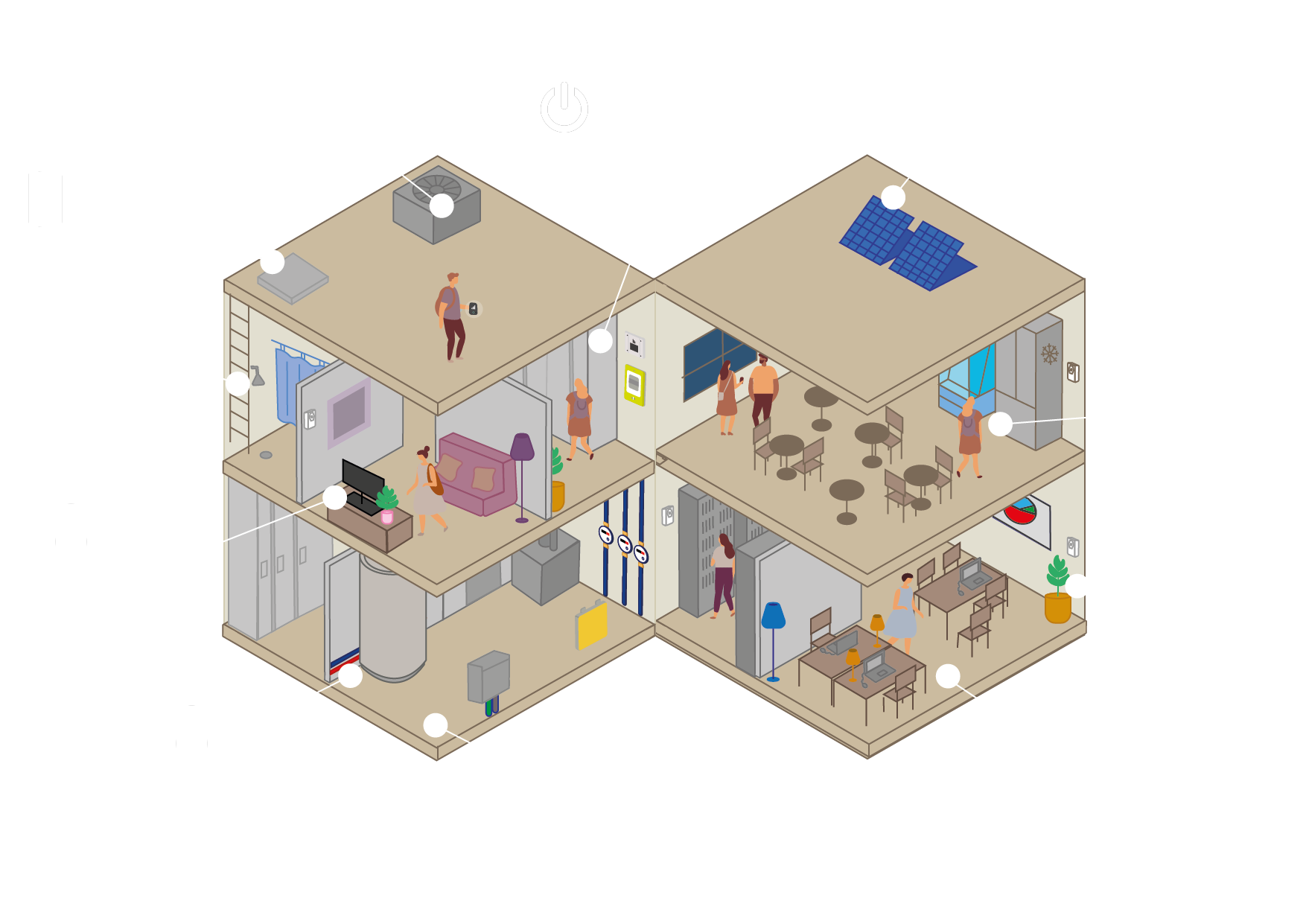
In smart building projects, this connectivity generally addresses three main objectives: energy performance, occupant comfort, and optimisation of technical operations.
Managing building energy performance
LoRaWAN enables the rapid deployment of energy monitoring solutions in existing buildings, without modifying existing infrastructure.
Through IoT sensors and energy sub-metering, it becomes possible to precisely track:
- electricity consumption
- HVAC usage
- water or gas consumption
- energy deviations
This data helps identify the most energy-intensive areas and prioritise optimisation actions.
Within the context of regulations such as the Tertiary Decree or the BACS Decree, this level of visibility becomes essential to track building performance over time.


Concrete use cases
- energy monitoring across a multi-site commercial property portfolio
- sub-metering of a boiler room
- HVAC consumption tracking
- detection of abnormal water consumption patterns
Improving comfort and indoor air quality
Connected buildings are no longer focused solely on reducing energy consumption. They must also ensure a level of comfort adapted to the actual needs of occupants.
LoRaWAN sensors enable continuous measurement of:
- temperature
- humidity
- CO₂
- indoor air quality
This data can then be integrated into supervision systems or BMS platforms to automatically adjust ventilation or heating.
This approach helps improve:
- occupant comfort
- workplace quality
- overall building energy performance

Concrete use cases
- CO₂ monitoring in schools
- heating optimisation in office buildings
- automatic ventilation adjustment
- thermal comfort monitoring in residential buildings
Optimising building operations and maintenance
LoRaWAN also plays a key role in day-to-day building operations.
IoT sensors enable continuous monitoring of technical equipment:
- boiler rooms
- ventilation systems
- electrical installations
- water networks
- critical technical equipment
Anomalies can be detected quickly, helping to reduce service interruptions and unnecessary site visits.
This approach enables maintenance to evolve:
- from a corrective approach
- to a data-driven preventive approach

Concrete use cases
- monitoring domestic hot water temperature and Legionella risk detection
- monitoring and preventing clogging of HVAC system filters
- alerts in case of equipment failure or performance drift
Meeting regulatory requirements
Building-related regulatory requirements are becoming increasingly stringent.
The French “Tertiary Decree”, indoor air quality monitoring obligations, and energy performance requirements all demand more precise and continuous monitoring of consumption and usage.
In this context, IoT provides a structured response.
It enables the production of reliable, continuous and actionable data required to manage performance and demonstrate compliance with implemented actions.
Without this field data foundation, it becomes difficult to ensure rigorous monitoring of regulatory targets.
LoRaWAN is a key infrastructure for supporting the transformation of buildings towards more efficient, controllable and scalable models.
Its ability to quickly connect existing equipment, centralise data and enable operational control makes it particularly well suited to today’s smart building challenges.
In a context of energy transition and increasing regulatory pressure, LoRaWAN provides a concrete answer for operators, integrators and property managers looking to modernise buildings without major renovation work.
Key takeaways: main LoRaWAN use cases in buildings

Monitoring energy consumption

Improving occupant comfort

Optimising maintenance operations
8- Why is LoRaWAN particularly well suited to smart buildings?
In smart building projects, the choice of connectivity technology is never neutral. It determines deployment simplicity, project scalability, and the ability to integrate into existing buildings without major works.
In this context, LoRaWAN stands out as a particularly suitable solution for connected buildings, especially in already constructed environments where technical and budget constraints are significant.
A technology designed for retrofit
One of LoRaWAN’s main strengths is its ability to equip existing buildings without structural modification.
Sensors can be installed quickly, without wiring and without interrupting site operations. This approach is particularly well suited to energy renovation projects, where intervention constraints are often significant.
It enables the gradual digitalisation of a property portfolio without requiring heavy works.
Low power consumption for long-term deployments
LoRaWAN sensors are designed to operate on battery power for several years.
This low energy consumption reduces maintenance interventions and ensures long-term service continuity.
However, not all sensors operate in the same way: some are battery-powered, with lifespan directly linked to transmission frequency, while others can be externally powered, particularly when integrated into building technical equipment.
This diversity allows the solution to be adapted to each use case, depending on field constraints and project objectives.
Coverage suited to complex environments
LoRaWAN is designed to provide long-range communication, even in constrained environments such as dense buildings or industrial sites.
Its ability to penetrate certain structural obstacles helps reduce the amount of required infrastructure while ensuring wide coverage.
Combined with proper radio planning and optimised equipment placement, it ensures reliable communication across the entire site.
A scalable and future-proof solution
A LoRaWAN project is not limited to an initial deployment.
It can evolve progressively, integrating new sensors, new use cases or new sites without redesigning the existing architecture.
This scalability makes it particularly suitable for organisations looking to digitalise their property portfolio step by step while maintaining overall consistency.
Reduced operational costs
By limiting field interventions, enabling remote monitoring and optimising maintenance, LoRaWAN directly contributes to reducing building operational costs.
It also enables better-targeted corrective actions based on reliable and continuous data.
9- How to successfully deploy a LoRaWAN project
A high-performing LoRaWAN project does not depend solely on the chosen technology, but on how it is designed, deployed and operated over time.
Success relies on a structured approach combining network qualification, device preparation, on-site deployment and data exploitation.
A rigorous radio mapping phase helps anticipate coverage constraints. Upstream preparation of sensors and configurations reduces installation errors. Finally, continuous monitoring ensures system reliability over time.
It is the combination of all these steps that transforms an IoT network into a true building management tool.
LoRaWAN should not be seen as a simple communication technology. It is a complete infrastructure capable of connecting buildings, structuring data and supporting their transformation towards greater efficiency and energy sobriety.

LORAWAN - FAQ
LoRa refers to the radio technology used to transmit data. LoRaWAN is the network protocol that manages and organises communication between devices and platforms.
Range strongly depends on the environment. Outdoors, coverage can reach several kilometres. Inside buildings, range varies depending on materials and radio obstacles.
Yes. LoRaWAN enables the connection of devices without major works or wiring, making it particularly well suited to retrofit projects.
Not necessarily. In a public LoRaWAN network, the infrastructure is operated by a network provider. Gateways are mainly used in private network architectures.
It mainly depends on the transmission frequency and the type of sensor. Some devices can operate on battery power for several years.
29/05/2026