Ventilation system maintenance
What you don’t see is already costing you money

What you don’t see is already costing you money
In a building, ventilation systems are often considered to be working as long as they are running.
On paper, everything seems in order: equipment is in place, air is circulating, systems have been commissioned. Yet in reality, things are rarely that simple.
Over time, performance changes. Filters gradually become clogged, networks lose their balance, and some components become less efficient. Nothing sudden, nothing immediately visible… but a slow, continuous drift.
And that is precisely where the problem lies: these ventilation system drifts are rarely detected without measurement.
Ventilation plays a central role in a building’s overall performance.
It directly affects indoor air quality (IAQ), occupant comfort, and the energy consumption of installations.
Insufficient air renewal can lead to stale air. Conversely, a poorly adjusted system can overconsume, especially when clogged filters or airflow imbalances force equipment to compensate.
In many cases, the lack of ventilation monitoring leads to invisible energy drifts that are difficult to detect without the right instrumentation.
A ventilation system can therefore continue to operate while no longer fulfilling its role effectively.
Over time, indoor air quality may deteriorate, airflow rates may become inadequate, and equipment may consume more energy to compensate for these discrepancies.
This “blind” mode of operation is still widely found in HVAC system management.
Today, ventilation system maintenance still relies largely on preventive approaches.
Interventions are scheduled at regular intervals, regardless of the actual condition of the systems. This approach has a major limitation: it does not allow performance to be tracked over time.
Between two maintenance operations, no reliable data is available to identify drift. As a result, some issues are detected too late, while other interventions are carried out unnecessarily.
This approach is reaching its limits in the face of current energy performance and indoor air quality challenges.
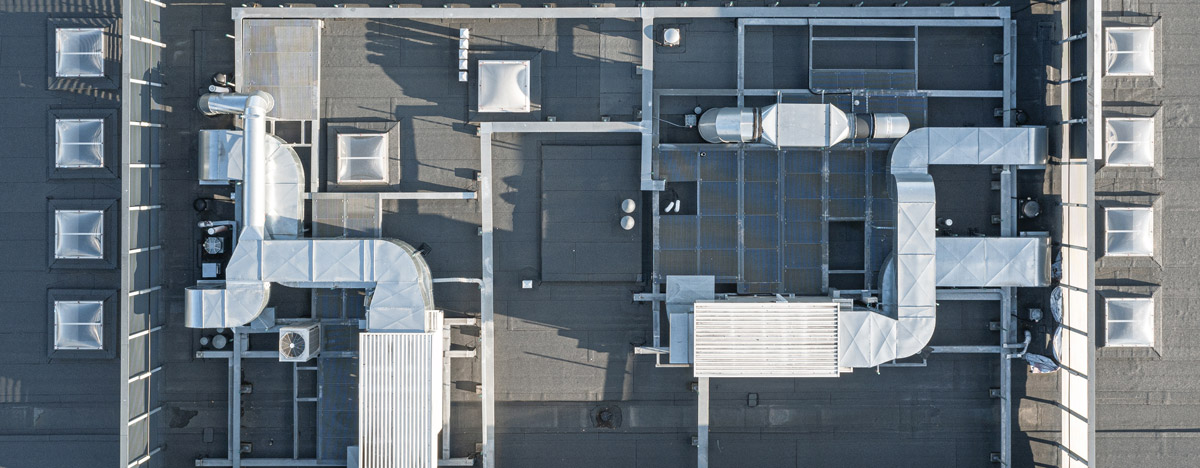
Applying IoT to ventilation systems makes it possible to move from occasional checks to continuous monitoring.
By integrating connected sensors directly into installations, it becomes possible to track key indicators in real time, such as differential pressure, a critical parameter for assessing filter condition and overall system performance.
IoT-based ventilation monitoring finally enables decisions to be based on real data rather than assumptions.
And contrary to common belief, deploying an IoT solution for ventilation does not require transforming existing infrastructure.
IoT sensors, particularly differential pressure sensors, are designed for quick on-site installation without heavy works. They operate autonomously and integrate easily into smart building or energy optimisation projects.
This ease of deployment is a key driver in accelerating the digitalisation of existing buildings.
Among the measurable parameters, differential pressure is particularly relevant.
It can be used to:
An IoT sensor such as the DELTA P, used in connected buildings, provides a simple yet highly effective way to continuously monitor a ventilation system.
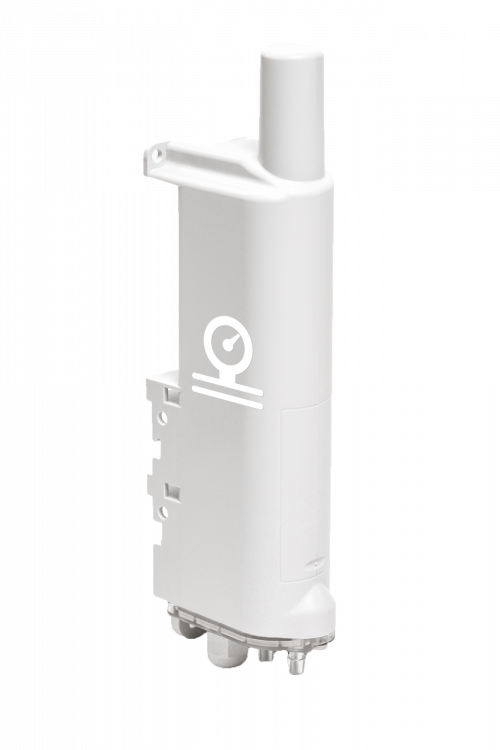
With continuous data availability, ventilation system maintenance evolves. Drifts are detected as soon as they appear, before becoming critical. Teams can then intervene in a targeted way, only when necessary.
This approach makes it possible to:
We are no longer simply talking about maintenance, but about managing the performance of ventilation systems.
Implementing IoT-based ventilation monitoring delivers measurable results.
It improves indoor air quality while reducing energy consumption linked to performance drift. Maintenance costs are better controlled, thanks to more relevant and better-planned interventions.
At the same time, equipment lifespan is extended, as systems operate under optimal conditions for longer.
All of this contributes to more efficient and more sustainable building management.
You cannot optimise a ventilation system without measuring it.
Thanks to IoT and the right sensors, such as differential pressure sensors, maintenance can be transformed into a true performance management tool.
Looking to implement simple and effective monitoring of your ventilation systems?
Discover how Adeunis solutions can support you in the field.
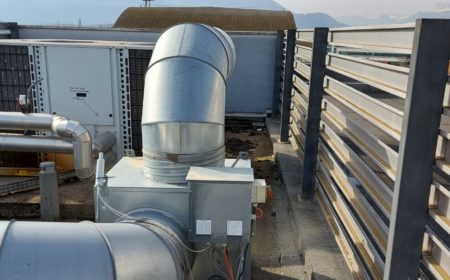
The most effective solution is to install IoT sensors capable of continuously measuring parameters such as differential pressure.
A Delta P sensor helps detect drift related to filters or imbalances, and optimise maintenance.
Preventive maintenance follows a fixed schedule, whereas IoT uses real data to ensure interventions only take place when necessary.
Yes, current solutions are designed for easy deployment without heavy infrastructure.
25/04//2026
Subscribe to our newsletter!
Your e-mail address is only used to send you our newsletter and information about our company. You can unsubscribe at any time using the link included in each email.